Fall 2011 Newsletter
Wednesday, December 7, 2011 at 1:19PM Check out the Fall 2011 Newsletter to see what San Bruno Mountain Watch has been up to for the last year.
Ken McIntire | Comments Off |
Wednesday, December 7, 2011 at 1:19PM Check out the Fall 2011 Newsletter to see what San Bruno Mountain Watch has been up to for the last year.
Wednesday, January 12, 2011 at 10:19PM Reprinted with permission of SouthSanFranciscoPatch
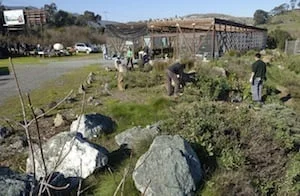
San Bruno Mountain Watch members investigated dirt bike tracks behind Terrabay neighborhood on Monday morning.
Walking through the Terrabay neighborhood Monday morning, three San Bruno Mountain Watch members looked for clues to where a dirt biker is entering the park.
South San Francisco residents Loretta Brooks, Chuck Heimstadt and Ken Oborn, all members of a San Bruno Mountain Watch conservancy committee, noticed the illegal tracks a week ago.
Brooks says dirt biking can destroy lupine, a primary food source for the endangered Mission Blue Butterfly, which is native to the mountain.
"We are trying to find a way to protect open space around here," Brooks said.
The group suspects that the dirt biker entered the park at the end of Highcrest Lane, off of Hillside Boulevard, where there is parking and easy access. A sign clearly marks that motorized bikes are prohibited in the park.
The sun peaked out from behind the clouds as water trickled down the verdant canyon and ravens circled overhead.
While hiking up the steep ascent, Brooks and Heimstadt pointed out a variety of invasive species, like fennel, radish and Italian thistle.
"The whole food chain is interconnected," Heimstadt said. "By bringing in the non-natives, it breaks up that food chain."
Native species like Blue-Eyed Grass, Sticky Monkey, and California Aster also sprout along the trail, but in fewer numbers.
The group wants to help the San Mateo County Parks Department weed out invasive species in the area but is waiting on a permit.
Heimstadt said there are multiple paths leading up the mountain, but all of them are steep.
"This was never a built trail," he said. "It needs to be switch backed."
The couple looks forward to a proposed east-west bike trail that would go from Oyster Point Marina to the ocean at Fort Funston. A new trail would be built from the base of San Bruno Mountain at Sister Cities Boulevard up to the Ridge Trail.
Hiking up the spine of the canyon past the blooming yellow petals of San Francisco Wallflower, the bike tracks became visible. The tracks zigzag on the mountainside between some rock outcroppings.
Two hikers made their way down, and Brooks asked if they've heard any bikes.
"It's against the law and it can ruin the habitat," she said. The hikers said they haven't seen anyone riding here but will contact authorities if they do.
"There's enough erosion on this mountain without [dirt biking]," Heimstadt says, " and then it's unsightly."
He says the county may be able to install a gate that would stop dirt bikers from entering.
Elias Frangos, park aide for the parks department, said he hadn't received any reports of dirt biking but they will look into it.
"We can definitely go check it out and keep an eye over there," Frangos said.
Wednesday, January 5, 2011 at 11:38AM Reprinted by Permission of Bay Nature Magazine, January-March 2011 Issue

"The Besieged Island." Left to right: two Callippe silverspots, Mission blue (male, left; female, right), San Bruno elfin. Painting by Liam O'Brien.
by Linda Watanabe McFerrin
Chuang Tzu and the Butterfly
Chuang Tzu in dream became a butterfly,
And the butterfly became Chuang Tzu at waking.
Which was the real--the butterfly or the man?
Who can tell the end of the endless changes of things?
The water that flows into the depth of the distant sea
Returns anon to the shallows of a transparent stream.
The man, raising melons outside the green gate of the city,
Was once the Prince of the East Hill.
So must rank and riches vanish.
You know it, still you toil and toil--what for?
--Li Po
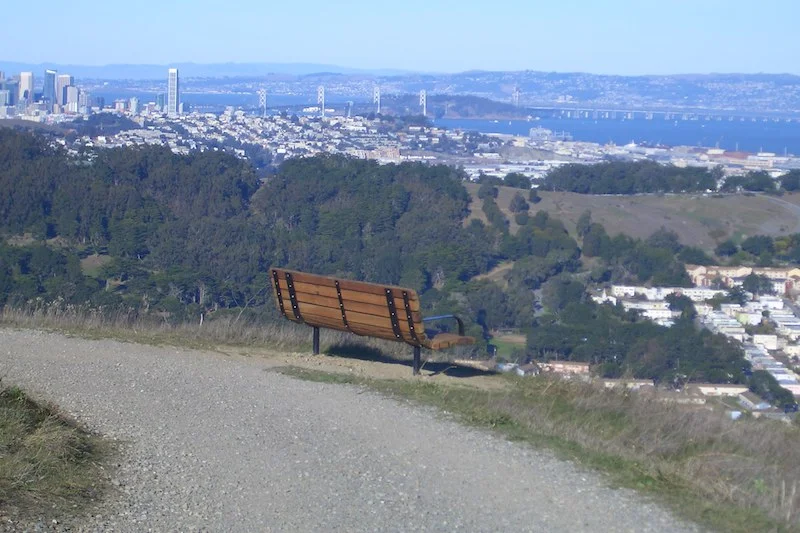
The world around us is aquiver on the Summit Loop Trail, the dusty 3.1-mile footpath that climbs through the chaparral, coastal scrub, oak woodland, and riparian habitats that cover San Bruno Mountain. I'm told that winds up here often reach 30 miles an hour, just shy of gale force. At around 1,300 feet this spot on the ridgeline at the northern end of San Mateo County looks out over most of the hyper-developed bay-centered core of the Bay Area. My hiking companion and I gaze northeast to the chalk-colored crenellated sprawl of San Francisco and southwest to suburbia and the cemeteries of Colma. We can just make out the traffic along the roads and freeways that crisscross the landscape below, but we can't hear it. "It's so quiet up here," I whisper. The leaves around us, shaking like minuscule flags, let loose a febrile rustle. The only other sounds are the whoosh of warm wind under my hat brim, the crunch of rock beneath our boots.
It might seem deserted, but it isn't. San Bruno Mountain State and County Park is densely populated, not with humans but with a vast array of wildlife, including a number of rare and imperiled plant species. I come here for the butterflies, to check up on a habitat essential to their existence, though I don't expect to see them flying around at this time of year, early fall. They should be well hidden as tightly wound pupae, sequestered beneath the carpet of vegetable litter that blankets the hillside, overwintering in dreamy diapause, dormant until spring. This is one of the last places on the planet where, if you know where and when to look and what to look for, you can see San Bruno elfin, Mission blue, and Callippe silverspot butterflies--all listed as endangered species, which is a terrible distinction as it is the last step before the end of the evolutionary road. The endangered bay checkerspot, too, once called the mountain home, but it has not been seen here in over a quarter century.
These are not large butterflies; they are small and discreet, certainly not flamboyant in the manner of monarchs and swallowtails, but still exquisite in color and design. Even so, it is not my intention to actually see them. I like that they are hidden, safe from harm in their pupal slumber. And, in any case, I have always been far more interested in the earlier, seemingly more durable stages of these insects' development. The adults in their mature imago form have always been ghosts to me; their fleeting presence, while beautiful, signals little more than doom. They represent a dilemma, a dangerous beauty, the alluring specter of transience; they mean hope for their kind in the ever-unfolding drama of life, but for the individual butterfly, nothing but death.
As a child I saw them as something fragile that, once caught, rarely lasted. When I was six, a small girl in England in a country landscape that was rich in flora and fauna, I filled glass jars with the interesting little creatures that slithered and crawled in the fields around my home. I collected creepy things: snails, slugs, beetles, spiders, and beautifully colored, magnificently furred caterpillars that I
liked to believe were patiently feeding on the blades of grass (in most cases a totally inappropriate food source) with which I had imprisoned them, unintentionally consigning them to an early death. Sometimes my captives were prettier and more active: ladybugs, honeybees, and the occasional unfortunate butterfly. The butterflies were quick to expire, their swift demise eventually reenacted by the other members of my glassed menagerie. Later, in the wild landscapes of northern Japan when I saw uniformed schoolchildren scouring the meadows with white butterfly nets, it would strike me that their enthusiasm was nothing more than a deadly innocence, the one perfect image of summer in a season that passed far too quickly, that was always too short.
I learned the facts about butterflies in high school: that they are members of the phylum Arthropoda; the class Insecta; the order Lepidoptera; and that in the course of their short lives they undergo metamorphosis through four stages--egg, larva, pupa, and adult. I remembered crying years before when one of the lovely caterpillars I'd gathered "died." It turned brown, shapeless, and still as a corpse, nestled in the greenery with which I'd stuffed its jar. Saddened, I threw the whole mess out. It wasn't until I saw a photograph years later of the next phase of a caterpillar's life that I realized my once-wriggling prisoner had simply entered another phase of its existence, not its last . . . that is, until I threw it out in ignorance. I wept all over again.
Here on San Bruno Mountain the butterflies' precarious hold on existence transcends the lives and deaths of the individual insects in each species. Parts of the mountain are currently protected, but the tenuousness of that preservation is written in the development encroaching from below. This 2,300-plus-acre patch of public land is surrounded by houses and subdivisions and has long been the focus of battles between developers and environmentalists. Inside the park another kind of intrusion threatens. Invasive species--eucalyptus, gorse, ivy, broom, fennel, cotoneaster, blackberry bramble--proliferate. The plants upon which the threatened butterflies feed compete with these hardy nonnatives for space.
On our slow ramble up and down the mountainside I contemplate all of this, and I feel a rising sense of pessimism. "If I were to write a butterfly song right now," I say, "it would be a lament, maybe even a dirge." I try to pick out the flora that constitutes the insects' specialized food sources: violets, stonecrop, native plantain, perennial lupines. What I see most are the transplants: ivy, fennel, and blackberries, blackberries everywhere. These plants, like humans, are opportunistic. They muscle out the less flexible species, devouring the natives' space.
That's when I see them. One, two, three--they are careening on winds so rough that I think their tiny bodies should be torn apart. Their appearance seems almost impossible and absurd to me, what with the fierce gusts and the lateness of the season, though adult butterflies can actually live for months. "Look," I say, my spirits lifting ridiculously even though I see the butterflies' erratic dance on the gales as nothing more than a frenetic totentanz.
The smallest of the three finds a sunny resting spot on the rocky path a few feet ahead of us. It flattens its wings, which tremble only slightly as I sneak up to take a closer look. I believe I recognize the markings. It's a checkerspot, but probably not the endangered bay checkerspot, which hasn't been seen here on San Bruno Mountain since the early 1980s. It's almost certainly the much more common cousin, the Chalcedon checkerspot. Still, for a moment, I feel the irrational joy again, to have found these persistent though delicate insects on this windswept hillside. And then the blast of sorrow that generally accompanies this joy--the realization that even as I observe it, the butterfly's life is ending, that the things I cherish--this parkland, the imperiled plants and animals that inhabit it--are in constant and unassailable jeopardy.
I am too close. The butterfly reacts, takes flight, another flitting bit of nature, blindly celebrating the expendability of forms. It's hard to resist that reckless dance and, for an instant only, I slip into its trance; and finally, blessedly, there is only this: the butterfly, the wind, the moment.
San Bruno Mountain Watch advocates for open space on the mountain and sponsors habitat restoration work parties every week. Learn more at mountainwatch.org, or call (415) 467-6631.
Linda Watanabe McFerrin has been traveling since she was two and writing about it--in poems, short stories, essays, and novels--since she was six. Her latest novel, Dead Love (deadlovebook.com), was published by Stone Bridge Press in 2010. She also leads workshops in fiction and creative nonfiction writing (lwmcferrin.com).
Bookmark This Page
Add Comment
Sunday, August 29, 2010 at 4:23PM Publisher: San Francisco Examiner
Reporter: Shaun Bishop
Monday, August 23, 2010 at 4:29PM Publisher: San Mateo County Times
Reporter: Julia Scott