
Doug's Mountain Journal
A Chronicle of Natural History on San Bruno Mountain
Doug Allshouse has been writing his seasonal Mountain Journal for many years. We are very pleased to share his reflections on the natural history of the Mountain. Together with David Nelson, he wrote San Bruno Mountain: A Guide to the Flora and Fauna. The book was published by Heyday Books in November 2022 and can be purchased here.
Summer 2025
The weather on San Bruno Mountain is crazy, and trying to figure it out is an absurd waste of time. The dance between cool and foggy, and sunny and warm involves the partners changing costumes several times a day without a care in the world. The day begins with a white-out sheet of fog and teases us with small windows of a clearer view, only to rip it away and replace it with more fog. Then you realize that this is what you signed up for to live 700 feet above sea level and three miles from the ocean. That eight-county view can get erased very quickly. Fog brings summer moisture to our native plants, but this year July did something that it hasn’t done in the Bay Area for a few decades. It managed to record a quarter of an inch of rain over five days. An additional 0.23 inches of fog over 17 days made this July the third wettest July since I began keeping records in 2013.
David Nelson and I visited Buckeye Canyon on July 5, to do our annual photo point survey. We started it in late spring of 2023 to take photos at fixed photo points to record the changes in vegetation since the mudslides scoured the lower canyon down to bedrock. We were doing fine this year through the first five photo points. We arrived at number six and were not able to render any photo looking back at number five because a few large Arroyo Willows blocked the view. At least a prediction that I made in the summer of 2023 came true. I surmised that in a couple of years that the lower canyon would be full of willows, toyons, coyote brush, and buckeyes. Thanks to the weeding efforts for the first couple of years, the hemlock and nightshade have been fairly well controlled. There was a good amount of wild lettuce (Lactuca virosa), which was a bummer. To offset that disappointment, a very nice discovery was made. We found some willow dock (Rumex salicifolius), which is the only native dock of the six species on the Mountain. Unlike its taller invasive relatives, it has prostrate to ascending stems that can reach 60 centimeters long, but they rarely reach much more than 10 to 12 centimeters above the ground. Buckeye and Owl Canyons have the greatest ratio of native to non-native plants than any other location or trail on the Mountain. Buckeye is 74% native, Owl is 84% native and combined they are 76% native.
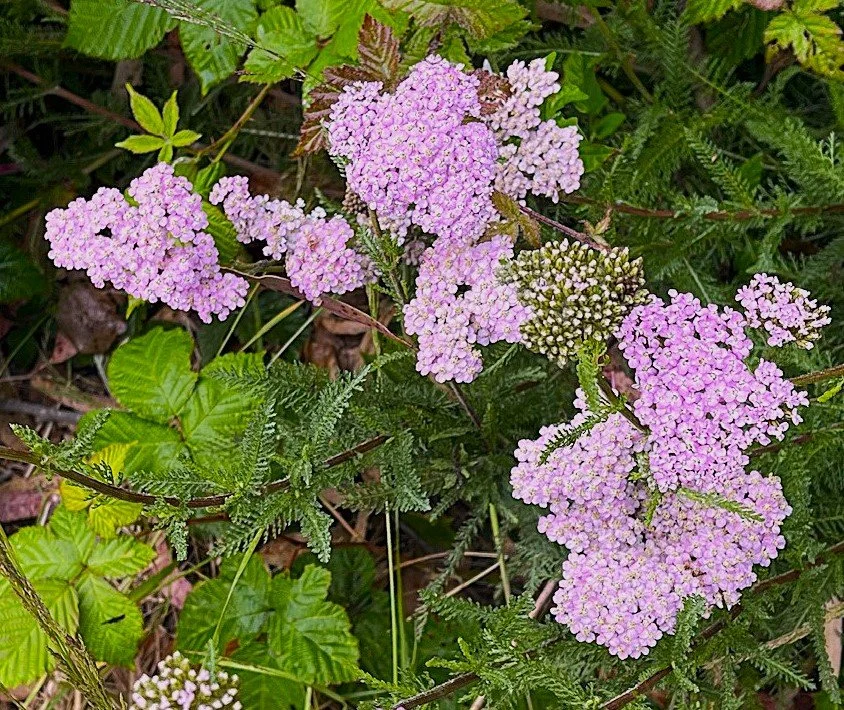
Common yarrow (Achillea millefolium) is abundant on San Bruno Mountain, as it is throughout the Northern Hemisphere. The plant's name honors the Greek warrior Achilles, with "millefolium" referencing the finely divided leaves—mille meaning "a thousand" and folium "leaf." The leaves, which have a medicinal aroma and contain the alkaloid achilleine, historically were used to slow or stop bleeding and treat wounds, as practiced by Achilles and our Indigenous peoples. While yarrow flowers are typically white, I have identified a persistent patch of pink-flowered plants along the Day Camp Road. Although horticulturalists have bred yarrow to produce a range of flower colors, these variants usually revert back to white over time; yet this patch remains vibrantly pink year after year, a testament to nature’s unpredictability and flair. I last photographed this patch in June 2021.
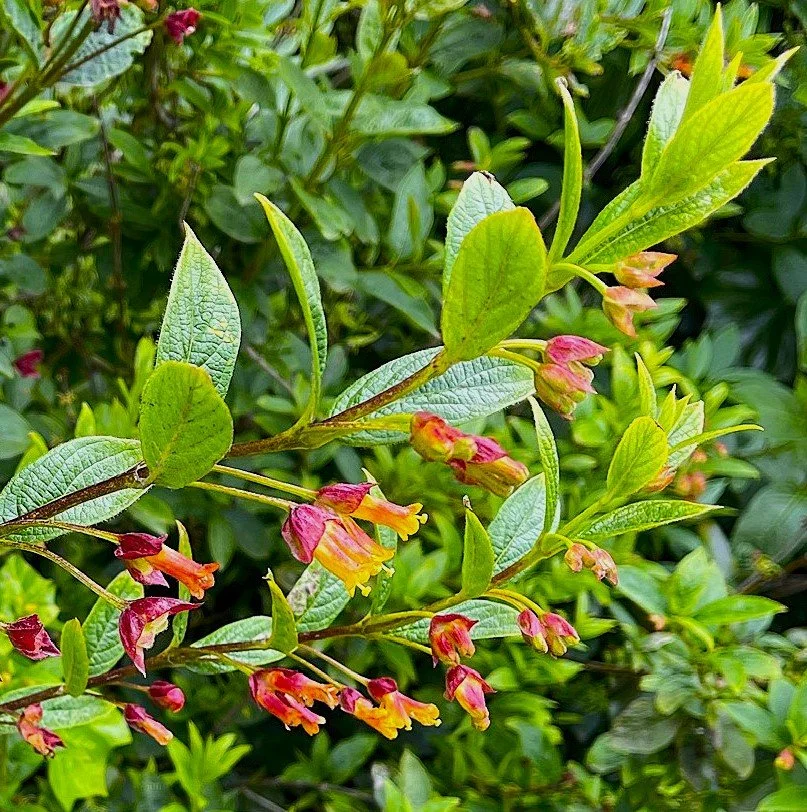
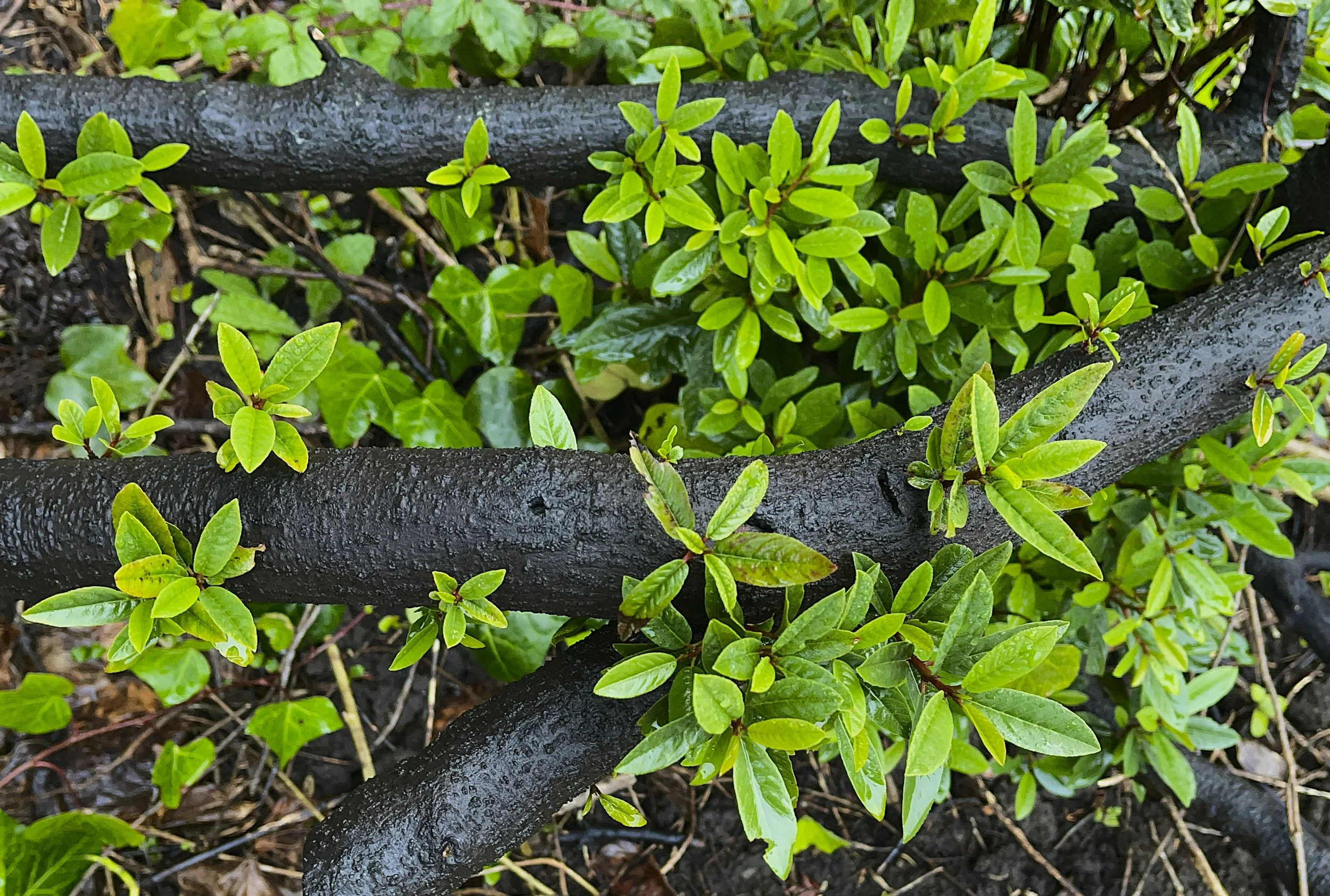
My ivy removal project on the Bog Trail has produced a few amazing surprises that prove the resilience of our native plants. The coffee berry bush that was once totally overwhelmed by the ivy is sprouting new leaves along the existing major trunk that will become new growth and add height to an otherwise vertically challenged bush. Another great surprise was the discovery of two twinberry bushes (Lonicera involucrata) and a coast red elderberry (Sambucus racemosa) along the trail that were hidden by the ivy. A brief session with my clippers freed them to flourish in their new unrestricted environment. This is, admittedly, a temporary condition that will require many future visits to the venue, clippers in hand.
I had two sightings of a Wilson’s Warbler on July 1 and 23. The past few Springs have produced a dearth of nesting bird songs. The Robins are still quite plentiful, but I miss the songs of Wilson’s and Orange-crowned Warblers, Common Yellowthroat, Olive-sided Flycatcher, Black-headed Grosbeak, and the Bullock’s Orioles that used to nest in the Day Camp. Some birders I know blame the aggressive and nest robbing Steller’s and Scrub Jays, but their populations are also down in the western Saddle area. I tend to think that the growing population of Ravens plays a large role in the dearth of songbirds that used to nest here.
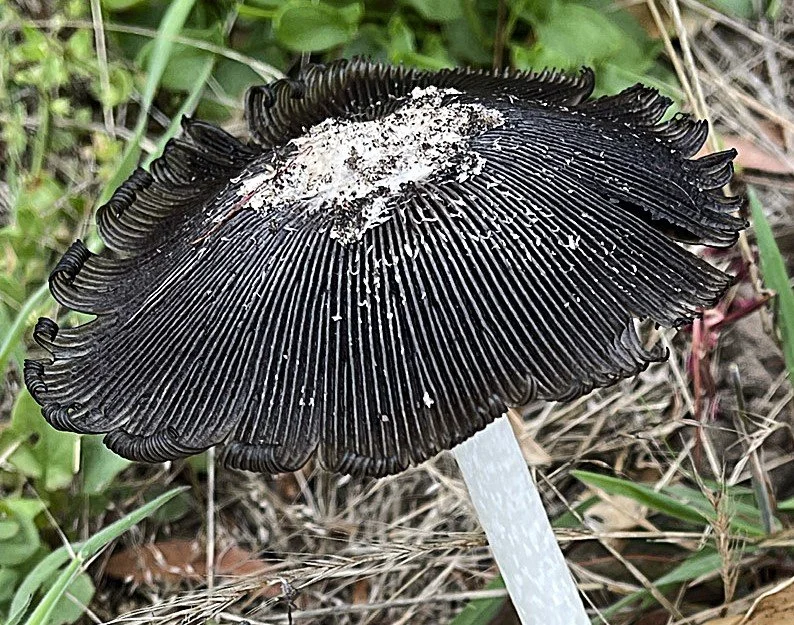
I stumbled upon a new fungus to add to the clan. This newcomer is known as Coprinopsis lagopus, commonly called the Harefoot mushroom for its fruiting bodies resemblance to a white rabbit’s paw. This delicate fungus is short-lived—the fruiting bodies dissolve into black ink within a few hours, a process known as deliquescence. The fruit bodies and caps are wildly variable in stem size from a millimeter to a couple of centimeters. It is really quite unique in appearance, but it is so sad that it is so short-lived.
SPECIAL ADDITION
I have been waiting twenty-four years to write this story. I made an appearance before the San Mateo County Board of Supervisors in late July 2001, on behalf of Friends of San Bruno Mountain. Mike Nevin was our supervisor. I held in my hands my copy of the April 20, 2001 Draft Master Plan for San Bruno Mountain State and County Park, which opened in 1985. This plan was expressing the desires and needs of the citizens at countless open meetings in the communities surrounding the park. I was lobbying the Board to move the construction of an interpretive center from Phase 3 (15 years out) to Phase 1 (3-5 years out). The Board voted 5-0 in favor of my request.
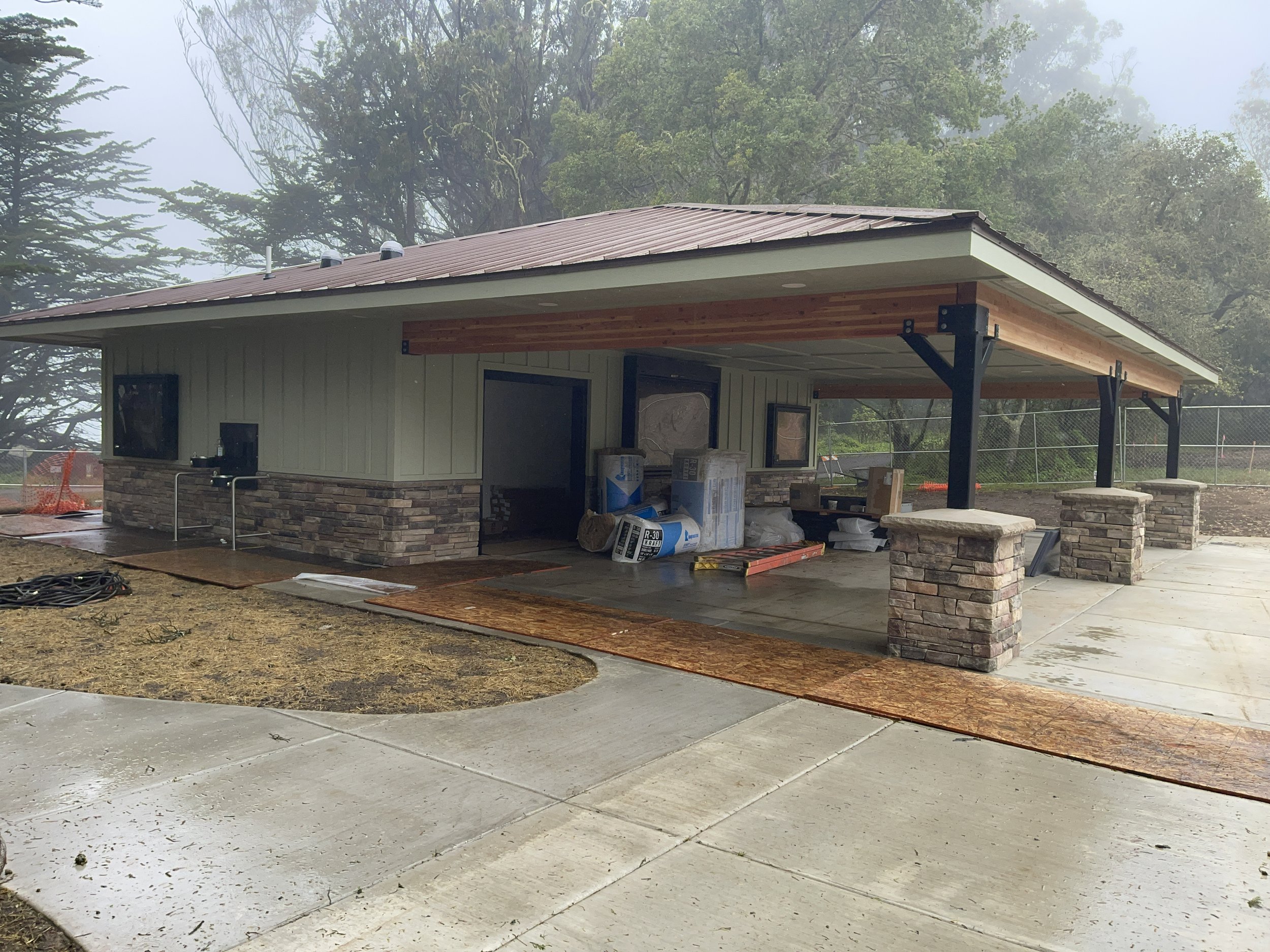
About twenty years later I discovered that the Board never voted to approve the Draft Master Plan. A couple of years ago, Parks created a website soliciting suggestions for a makeover of the main picnic area. A few conversations with our supervisor, David Canepa, flirted with the idea of a brick-and-mortar interpretive center near the parking lot with meeting space and displays. What the County envisioned, and had a budget for, was a new building of four unisex restrooms with an attached pavilion. It will have interpretive displays and a large video monitor. The monitor is encased within a 2,000-pound enclosure with locks and a roll-down metal curtain. The interpretive material is being supplied by David Nelson, San Bruno Mountain Watch’s Ann Kircher, Ariel Cherbowsky Corkidi, and Russ Aguilar and the County Parks Interpretive division.
Construction began on July 3rd with a crew from Oregon who contract with Oregon-based ROMTEC, a company that designs prefab restrooms and pavilions for parks or open spaces. The crew worked seven days a week, twelve hours a day, and completed construction on August 26. Grading is being done for a paved road around the west, south, and east side of the meadow. New and expanded ADA parking has been completed, and two paved entrance paths will supply access to the meadow.
See you on the Mountain
Doug