
Doug's Mountain Journal
A Chronicle of Natural History on San Bruno Mountain
Doug Allshouse has been writing his seasonal Mountain Journal for many years. We are very pleased to share his reflections on the natural history of the Mountain. Together with David Nelson, he wrote San Bruno Mountain: A Guide to the Flora and Fauna. The book was published by Heyday Books in November 2022 and can be purchased here.
Summer 2026
I really love the Mountain with its four square miles of botanical bliss. There are 14 rare and endangered plants, five endemic plants, four federally listed endangered and threatened butterflies and the only place on our planet where all four co-exist. It is no wonder that E.O Wilson of Harvard University declared—40 years ago—San Bruno Mountain as one of 18 ecological hotspots in the world. That is very significant when you consider that now the list has exploded into the hundreds.
When we think about the meaning of rare, threatened and endangered plants (RTE) on San Bruno Mountain the original list of fourteen gets expanded. There are many more plants that we call forbs, herbs or wildflowers, that are locally RTE. Since 2014 we have rediscovered San Francisco campion (Silene verecunda) and Choris’s popcorn flower (Plagiobothrys chorisianus var, chorisianus). Both were thought to be extirpated from the Mountain. There is also a list of plants that have only one known population here. A very disturbing trend that has surfaced is that rare plants are losing numbers and locations. Scouler’s catchfly (Silene scouleri subsp. scouleri) was once plentiful in the grasslands and rocky outcrops along the Ridge and Dairy Ravine Trails, Army Road, Devil’s Arroyo, and Owl Canyon. In a few of those areas the plants have literally disappeared. David Nelson and I have concluded that rabbits are the culprit. Due to a lack of seasonal fires that were spiritually practiced by our indigenous peoples, the spread of coyote brush into the grasslands has exploded. As the brush spreads closer to the catchflies, it offers cover to the rabbits from the hawks and other raptors in the form of a “scurry zone”; a finite amount of real estate just beyond the bush that allows the rabbit to seek cover in mere seconds from a predator. We are gathering seeds from a few plants to be grown at the Mission Blue Nursery for planting in the future, but all that accomplishes is supplying more food to the rabbits. It is time for us to consider manual removal or indigenous burning that is being done elsewhere in our state with impressive results.
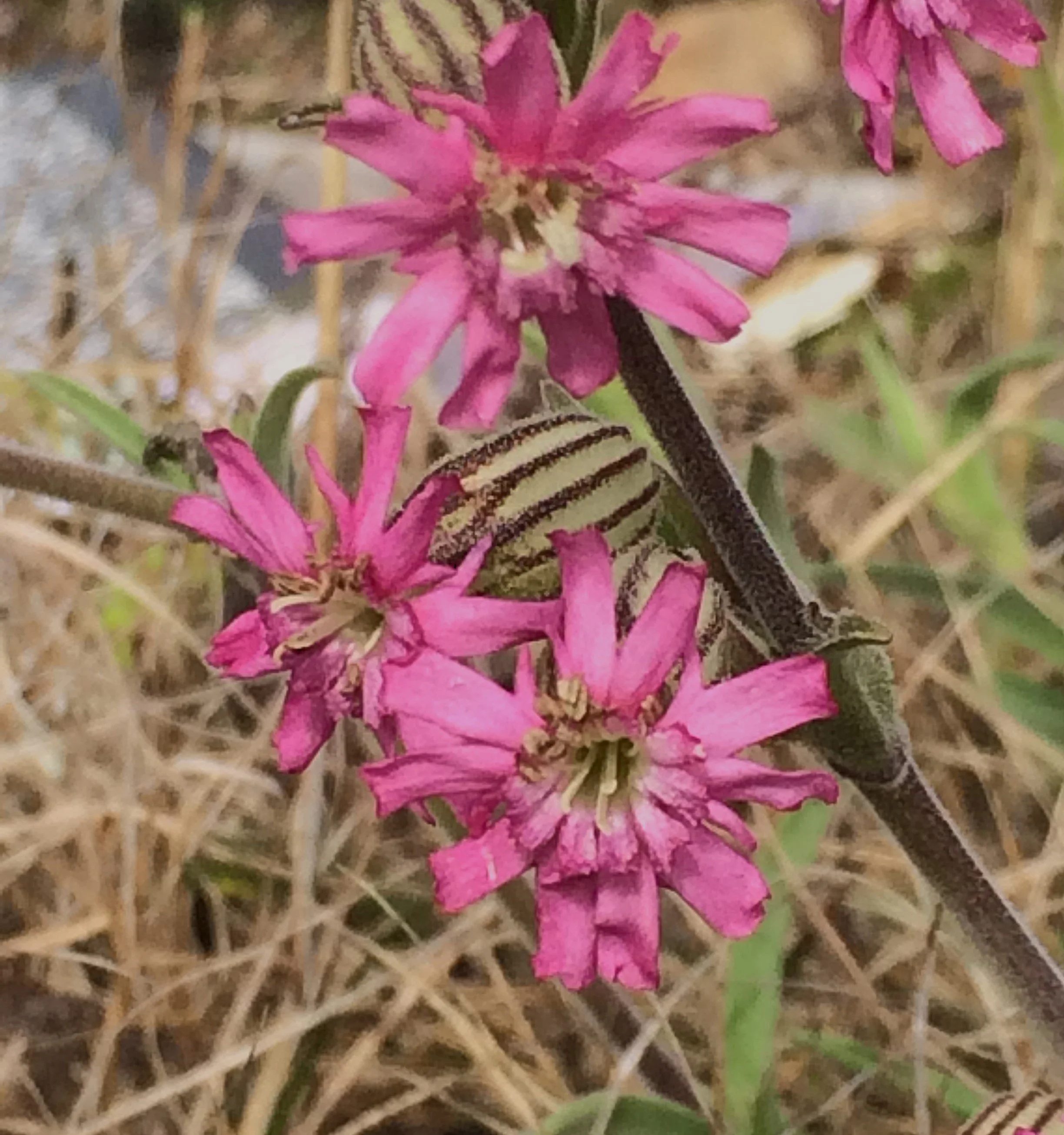
Scouler’s catchfly
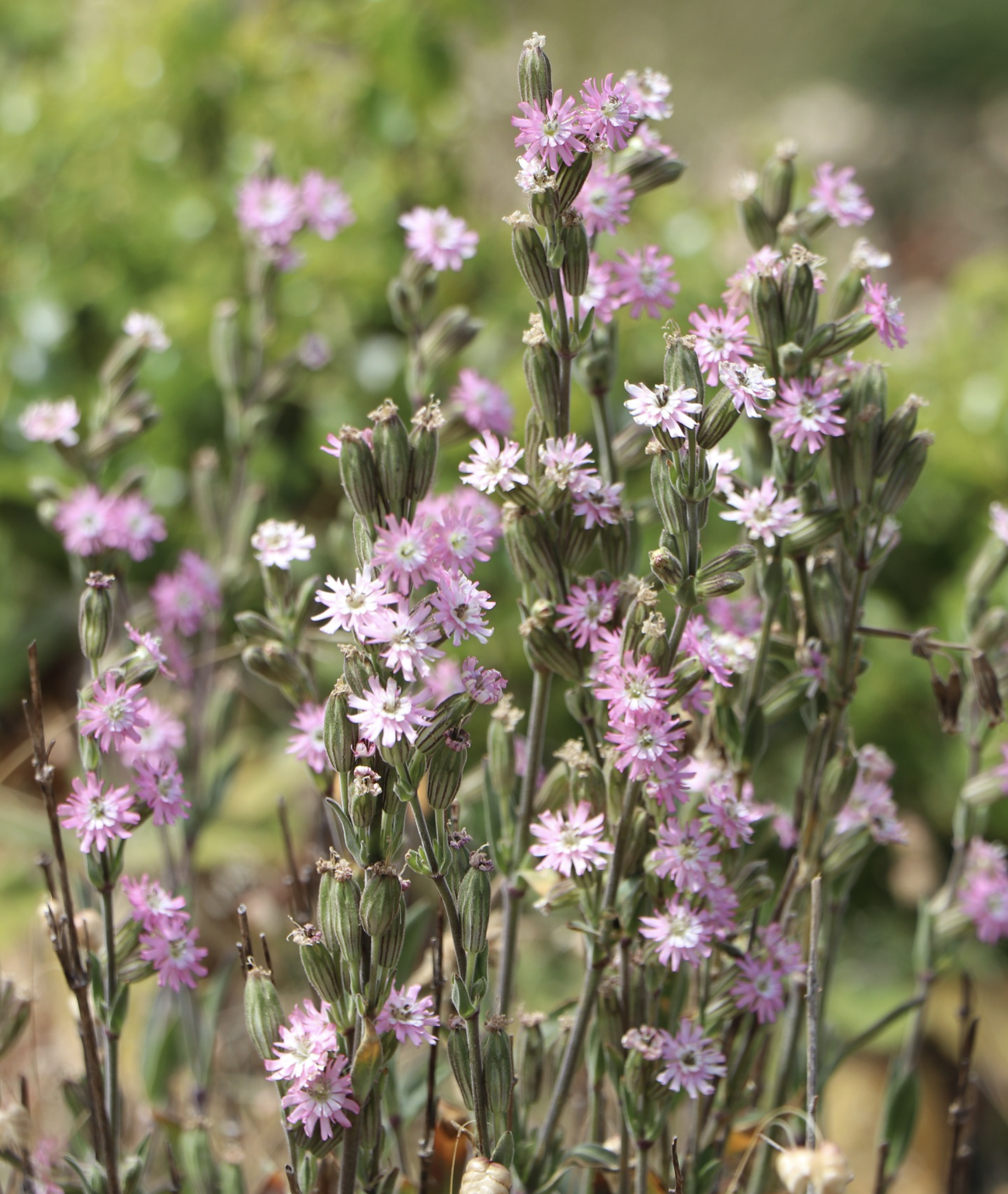

Choris’s popcorn flower
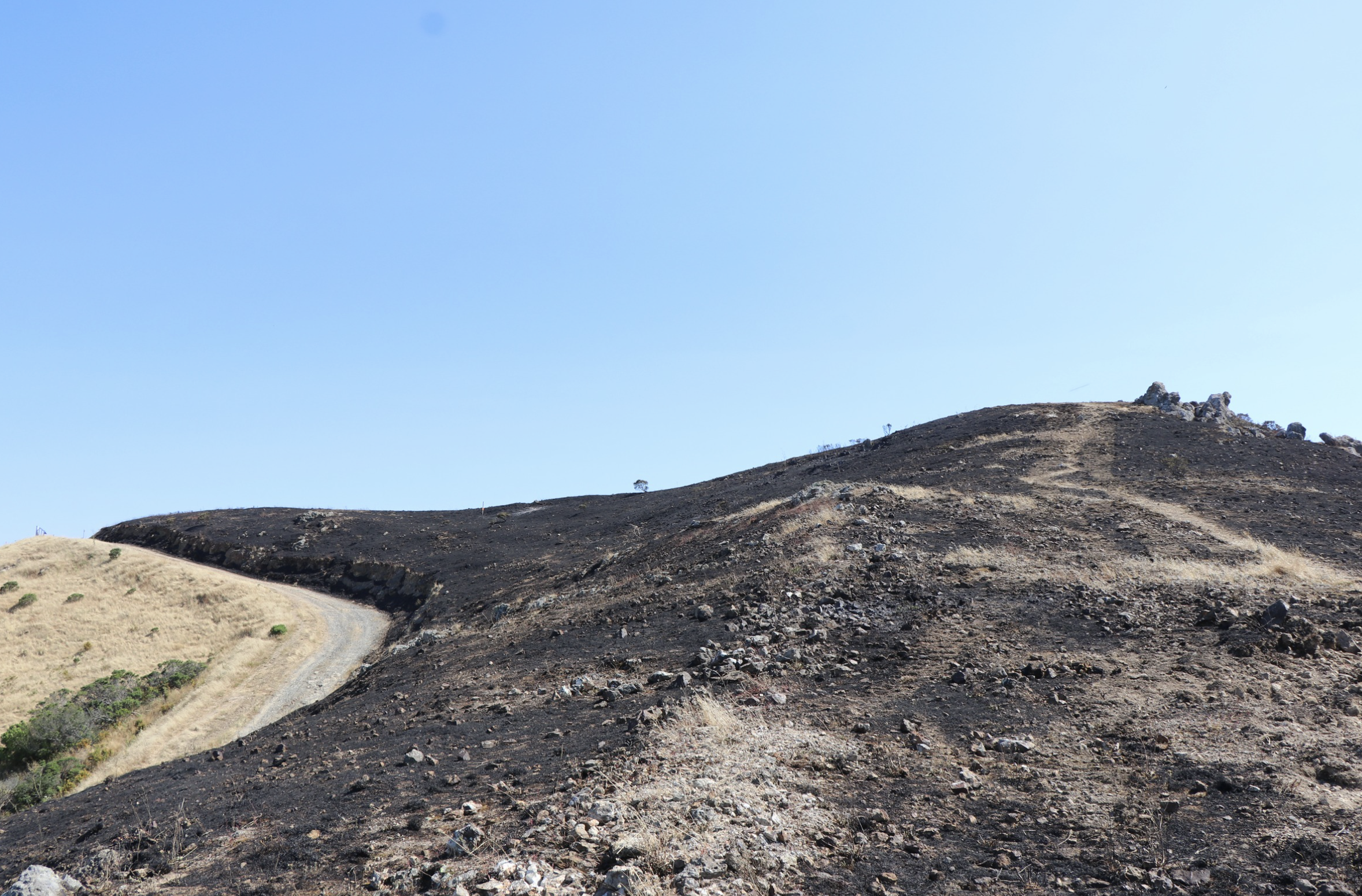
This hillside was covered in goldfields, golden violets, and emerald grass in the springtime following this burn.
Fire is not a disturbance; the LACK of fire is the disturbance (David Nelson). Do yourself a favor: look at the burn area of the next wildfire on the Mountain during the end of the following winter. You will see that the grass in the burn area is a bright emerald compared to the surrounding greenery. That tells you that the dead material (thatch) has been burned away and life-enhancing minerals have enriched the soil.
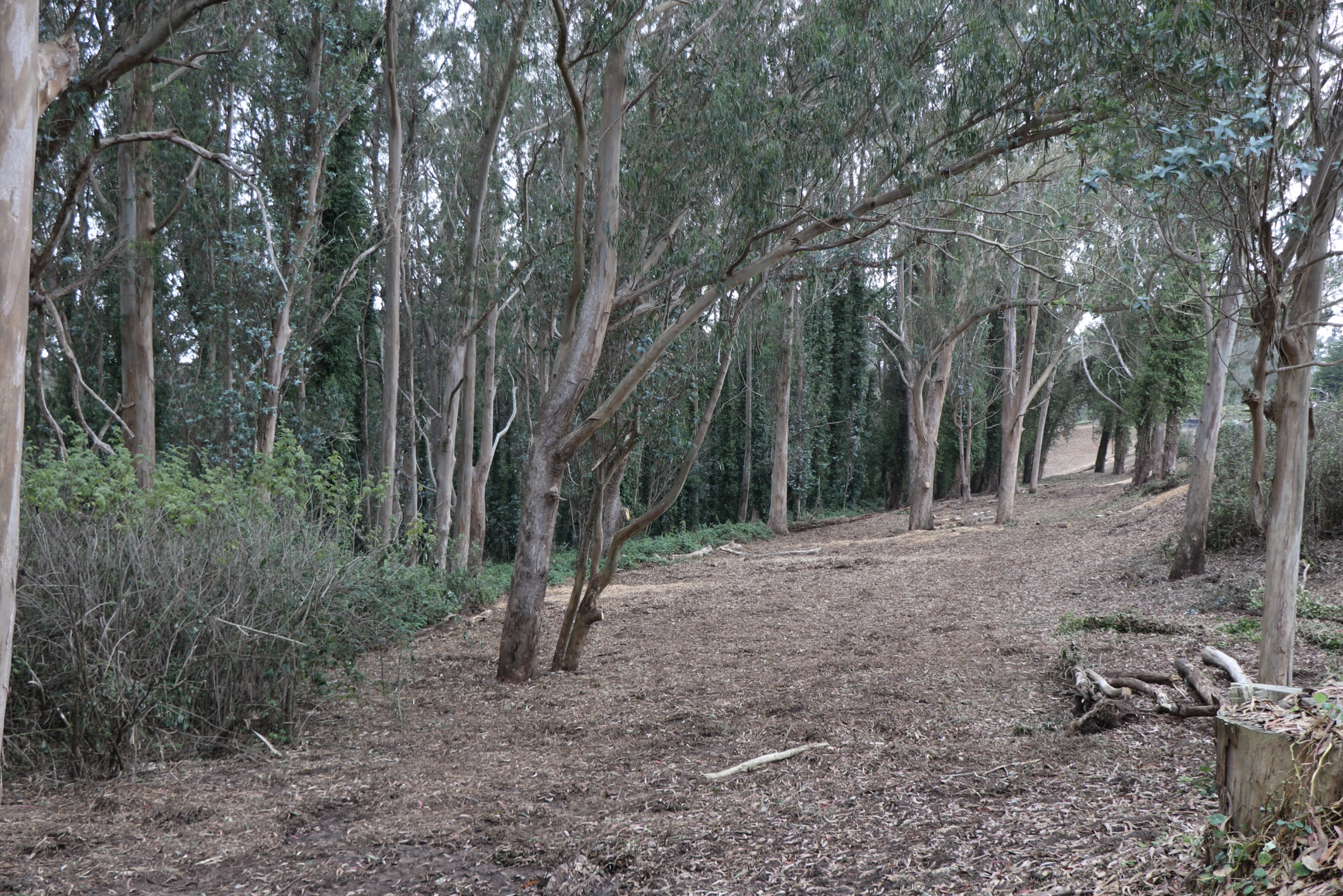
We have had several rounds of eucalyptus logging along the Old Guadalupe Trail with more to come. A recent job by Davey Tree removed about twenty large trees and created a couple of open spaces that are roughly 40 to 50 feet wide by 20 to 30 feet deep. One of the spaces has a fairly large wax myrtle tree growing naturally in an area that was once a more crowded eucalyptus forest. I envision more native trees in those spaces such as oaks, toyons, coffee berries and more wax myrtles. Perhaps that would attract more birds to nest here and also provide food over several seasons. It couldn’t hurt and would be a lofty and attractive experiment.
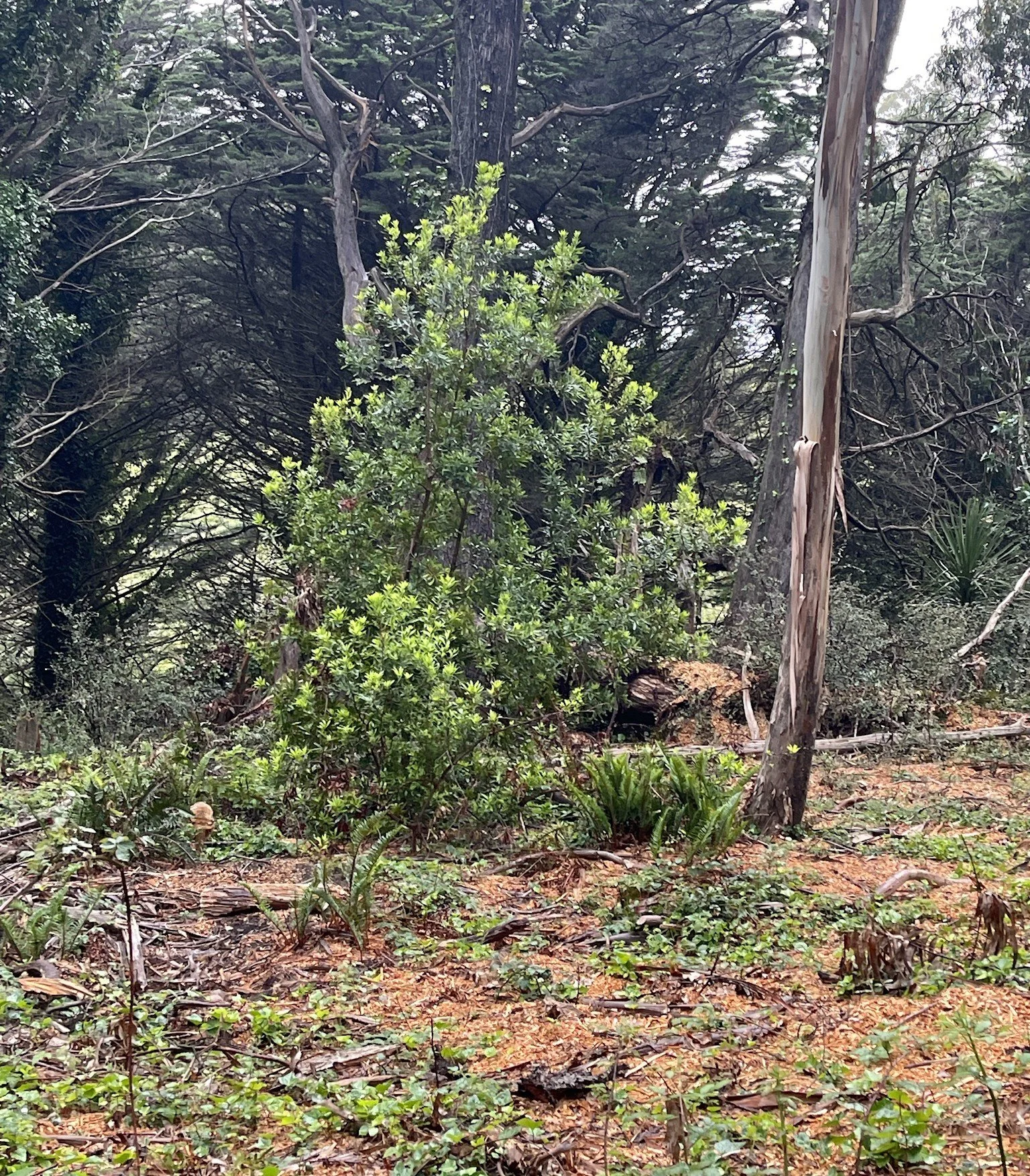
Pacific wax myrtle
The endangered San Bruno elfin butterfly is an early riser, completing its pupal stage and emerging as an adult in late February and completing its life cycle around late April. The larvae are visible in May and June when the larvae migrate from the succulent leaves to the nutritious flowers. Their host plant, stonecrop, is a succulent plant that is commonly attracted to north-facing rocky outcrops. Its genus (Sedum) means “to sit” and its species (spathulifolium) means “spoon-shaped” for the leaves. The thick and fleshy leaves turn darker red late in the season and eventually turn a pinkish orange, as they did in summer this year. They have a particularly subtle beauty in all phases of their life cycle. The elfin was not really considered in the Habitat Conservation Plan since its habitat is restricted to the upper elevations of the main ridge and Bone Yard Quarry in lower Colma Canyon. No “take” for this species was considered in the development covered in the HCP.
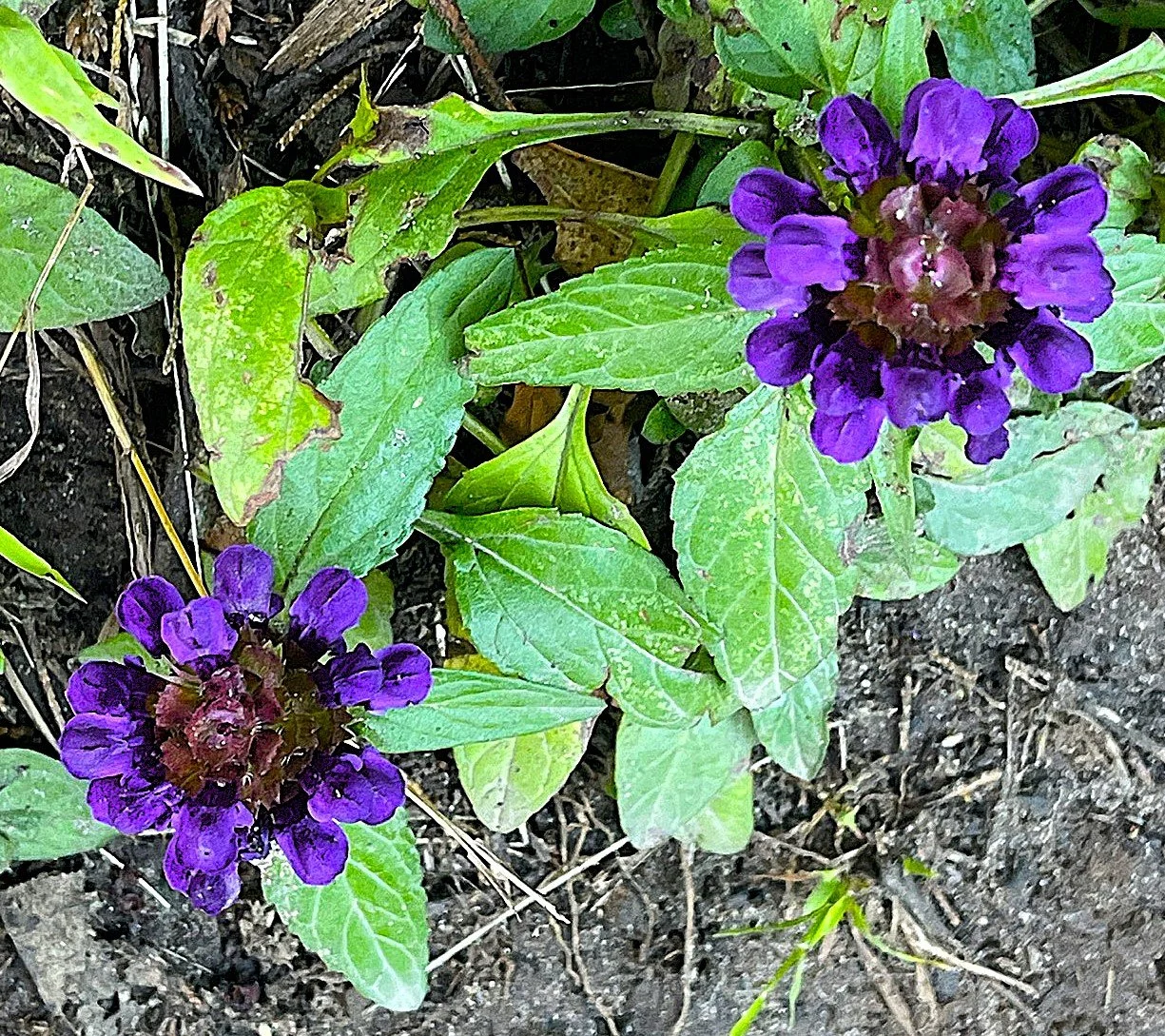
self-heal
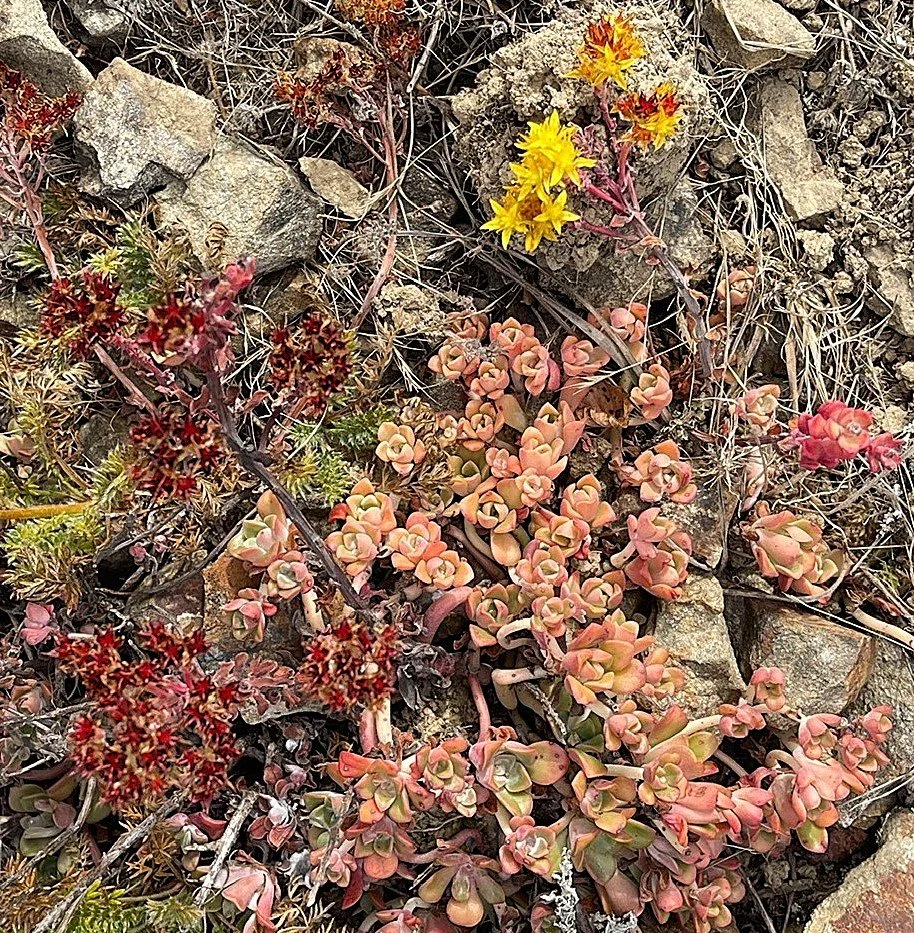
Pacific stonecrop
Another little guy that never visually disappoints is self-heal (Prunella vulgaris), which is one of the few members of the mint family that lacks a scent. It loves moist and semi-shady areas and more than makes up for its lack of minty aromas by being a champion medicinal plant. Its genus, prunella, is an early German word for quinsy, a malady (chest pain) that it was used to treat. It is edible and rich in vitamins A, C and K, and also was used to treat sore throats, fever, and diarrhea. Wow, talk about head to tail coverage!
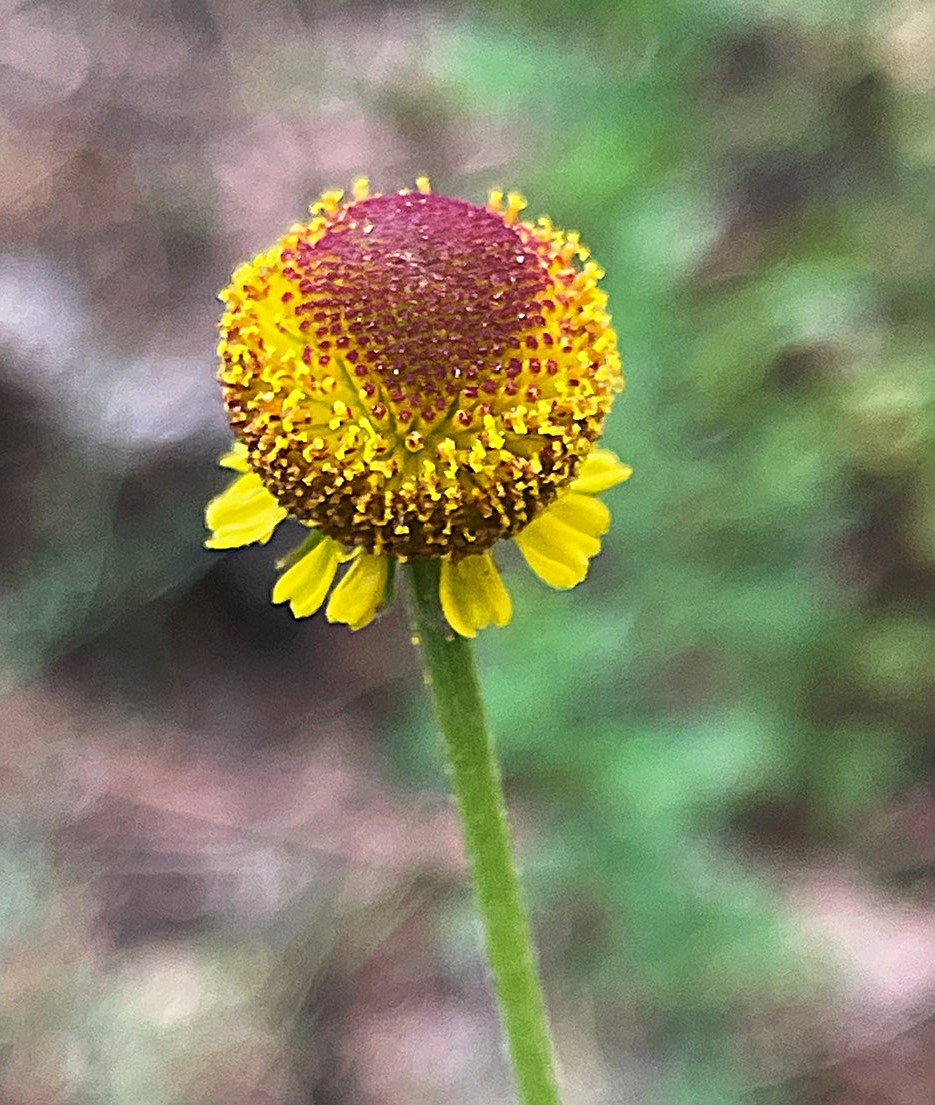
sneezeweed
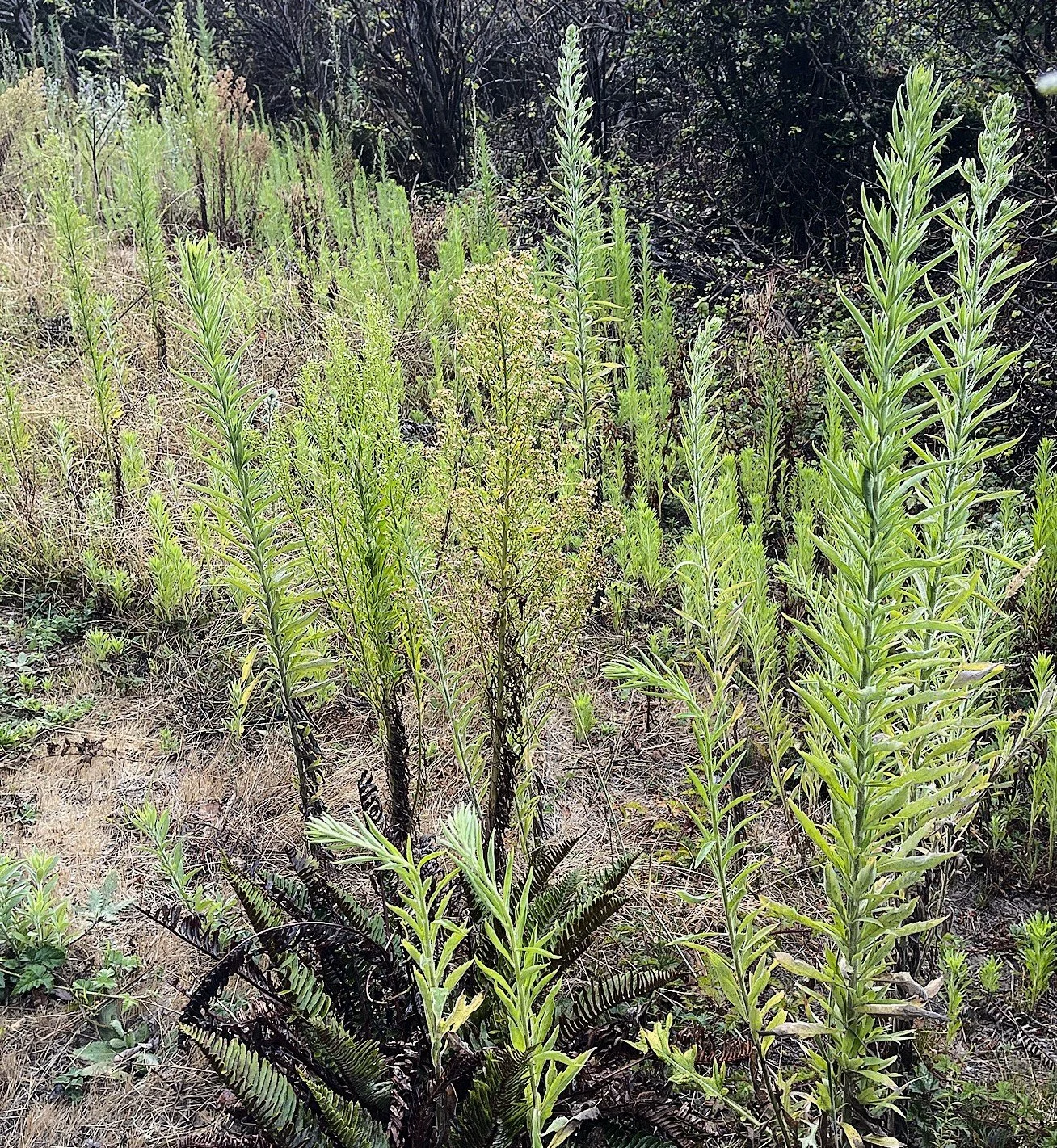
horseweed
One of the more popular plants in the Mountain Watch bog gardens is sneezeweed (Helenium). It is a large plant—up to a meter tall—with long basal leaves and a really strange flower. At the end of a naked peduncle (stem) is a solitary hemispheric flower with 300-500 tiny disc flowers that are yellow when young and turn darker with age. There are many very short ray flowers around the outer edge. It is called sneezeweed because it appears that the flower has sneezed off its down-turned ray petals.
The major restoration project of the Bog Trail in 2024 removed a huge number of invasive weeds. As time goes by, we get to see how Mother Nature reacts to her new environment. As I wrote about this in a prior journal, I have been doing some major weeding in several spots since then. I removed a lot of Algerian ivy behind a bench in one spot so that I could access the trunk of perhaps the healthiest redwood tree in the entire park. There are only a few, and they were planted many years ago. I pulled Cape Ivy in another spot close by. The result is that both places have become homes to horseweed (Erigeron canadensis), a mid-summer to fall native that feeds birds at a time when food choices get a tad slim. It seems to love the Bog Trail since it also appears along the trail’s edges.
I last wrote about a fungus called Chicken-of-the-woods (Laetiporus sulphureus) in my 2024 Summer journal. It’s back and seems to reappear about every two years. Here is what I wrote two years ago.
[At least five years ago I saw a shelf fungus growing on a eucalyptus at the junction of the Old Guadalupe and Bog trails. I hadn’t seen much of it since, but it made a grand appearance in early August. It’s commonly known as chicken-of-the-woods or scientifically as Laetiporus sulphereus, a bright and bold polypore fungus. As a polypore fungus, it has pores on its underside instead of gills and is edible although the novice should take caution in its preparation. It is a saprophyte, which is an organism that feeds on dead material. So, what is a saprophyte doing on a live tree? It is commonly- found on wounds on trees and causes brown rot, which is slowly killing its host. It may take a while since this tree is about sixty feet tall.]
Well, guess what? As of August 2026, the eucalyptus tree has been declared to be dead. It’s amazing what a stunning fungal saprophyte can accomplish. If you notice that the bark on the trunk does not resemble the bark of a typical blue-gum eucalyptus, give yourself a gold star. However, that anomaly only exists for about 15 feet up the trunk where it abruptly becomes the smooth bark we associate with the species globulus.
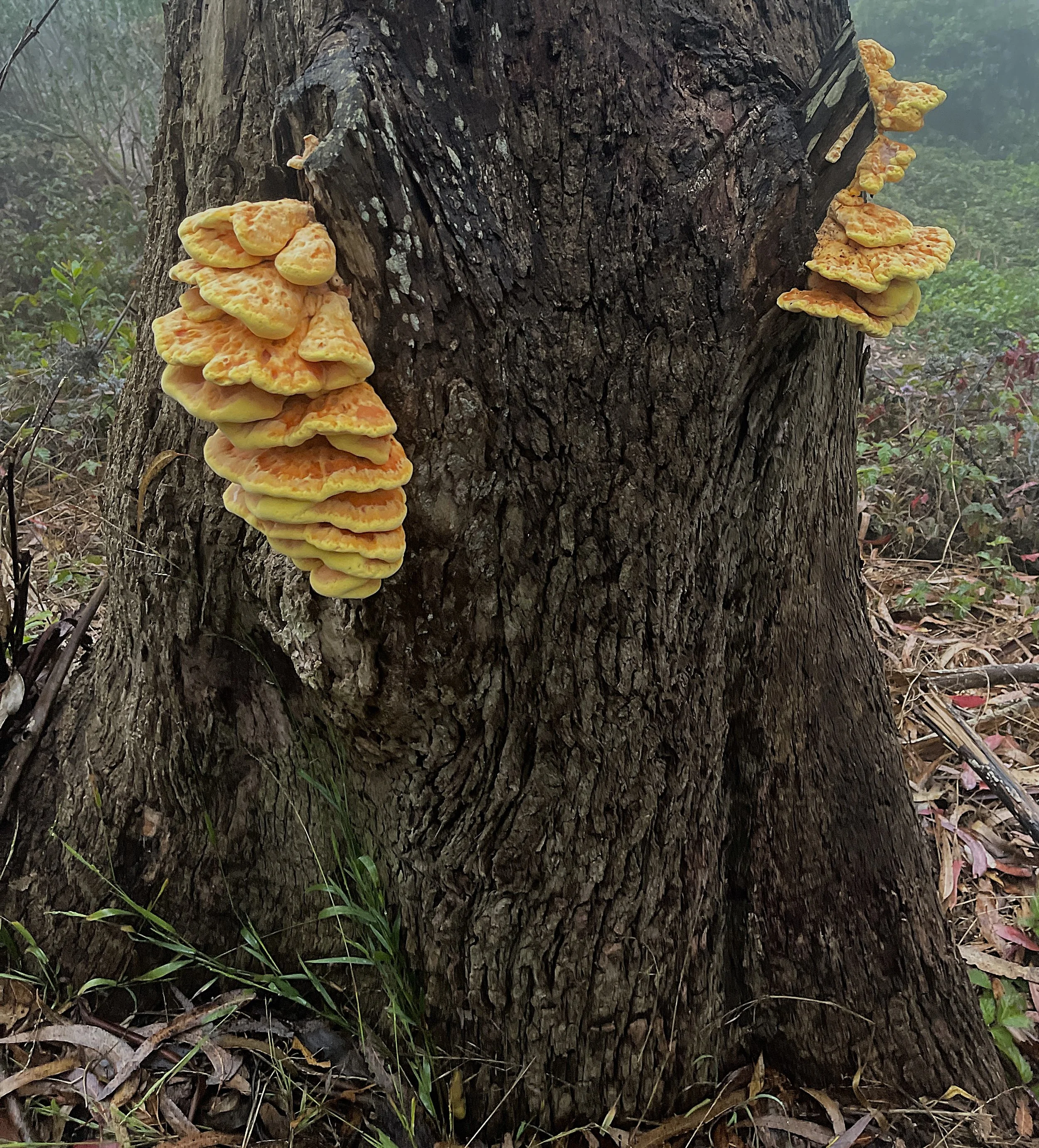
chicken-of-the-woods
There have also been an alarming number of baby brush rabbits that have been found dead along the trails of the northern portion of the mountain. This is somewhat common with the rabbit population of fluctuating numbers from year to year. If you saw dead rabbits, you were not alone.
Summer weather is finishing on the mild side except for a three-day hot spell a couple of weeks before the equinox. (No sky) July was the second driest recorded by me at just 0.14 inches of fog and 0.01 inches of rain. Many days were foggy with little moisture. August (Fogust) was quite wet with a record 24 days and 0.44 inches of fog, second only to August 2020-2021 with 0.49 Inches. Rain was about average with 0.12 inches from a mild tropical depression mid-month. With a very hot and huge El Niño brewing in the waters off the coast of Mexico, late autumn and winter might be a wild ride of atmospheric rivers hitting our state. Hopefully, there will be no mudslides like December 31, 2022. Brisbane and the Mountain do not want or need a repeat.
With our traditionally “best weather on the coast” just around the corner, it is a great time to get out and explore.
See you on the Mountain,
Doug